QR CODE RA ĐỜI LÀ VÌ BARCODE ĐÃ QUÁ HẠN HẸP CHỈ CÓ THỂ CHỨA TỐI ĐA 20 CON SỐ ĐƯỢC BARCODE MÃ HÓA MÀ THÔI- DO NHU CẦU ĐÒI HỎI NÊN ÔNG NHỰT BỔN DENSO WAVE CHẾ RA QR CODE (QUICK REPOND CODE) VỚI KHẢ NĂNG CÓ THỂ MÃ HÓA ĐẾN 7000 SỐ VÀ NHẠY CẢM GẤP 10 LẦN SO VỚI CÁC MÃ HÓA KHÁC./-TCL
QR Code LÀ GÌ?
 Mã ma trận là cái quái gì ???
Mã
ma trận “QR code” được phát minh từ năm 1994 dùng trong kỹ nghệ sản
xuất xe hơi, nhưng mãi cho đến khi có nạn dịch Covid-19 thì ta mới nhìn
thấy mã này xuất hiện tại nhiều nơi.
Từ
các quán ăn, nhà hàng, nơi giải trí v.v. nói chung là các doanh nghiệp
thường có dán bộ mã này trước cửa và yêu cầu khách hàng dùng Mobile
phone quét bộ mã trước khi được phục vụ.
Từ
lâu chúng ta đã làm quen với bộ mã vạch tức là barcode, thường in trên
các sản phẩm. Người bán dùng máy quét mã vạch để tính tiền. Bộ mã này
gồm những sọc thẳng đứng và các số, chứa đựng các thông tin về sản phẩm
và giá cả.
Mã vạch, barcode:  Bây giờ lại thêm mã ma trận “QR code”, gồm những hình ảnh kỳ quái nên được người Việt trong nước gọi là ma trận. Vậy mã ma trận chứa đựng thông tin gì?
Tóm
gọn mã ma trận chỉ chứa đựng một hàng chữ, thường là một URL, tức là
Uniform Resource Locator mà chúng ta thường gọi là Web address tức là
địa chĩ một website.
Đôi
khi mã ma trận chứa đựng một hàng chữ để vui chơi như “Hello” – “How
are you” v.v.. Nếu bạn có con em làm trong ngành viết program tức lập
trình cho máy tính, hãy nhờ họ làm cho bạn một mã ma trận chứa tên của
bạn, thí dụ như Danh Nguyen, David Ngo, Kennedy v.v.
Quý bạn hãy chú ý hai hình bên dưới, để có thể biết cách đọc mã ma trận.
– Hình 1 – – Hình 2 – 
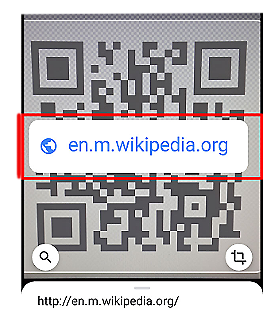
Cách đọc mã ma trận:
1/
Hãy mở cái mobile phone, Iphone hay Android phone đều được. 2/ Mở máy
chụp ảnh của mobile phone. 3/ Tìm một hình mã ma trận ở đâu đó,
có thể trước một quán ăn, một nhà hàng, trong khu shopping gần
nhà và kê ống kính ngay cái mã ma trận, xê dịch cái mobile phone xa
hay gần cái mã, cho đến khi thấy hình cái mã ma trận xuất hiện trọn vẹn
trên màn ảnh kèm theo một hàng chữ gì đó.
Thí dụ tôi đã làm: hình
1 bên trái là hình bộ mã in trên giấy – hình 2 bên phải là hình bộ mã
đó hiện trên máy ảnh mobile phone của tôi với địa chĩ trang web của công
ty Wikipedia. Khi hình 2 hiện lên trên máy ảnh, sẽ có hàng chữ yêu cầu bạn gõ ngay vào địa chĩ trang web để nhập vào trang đó.
Hiện
nay, chính phủ Úc đang yêu cầu các doanh nghiệp phải đăng ký “Doanh
nghiệp an toàn với Covid” trong đó có thiết lập mã ma trận riêng cho cơ
sở của mình. Chi tiết nơi đây:
https://www.nsw.gov.au/covid-19/covid-safe?language=vi
Khi
chúng ta đi vào một doanh nghiệp như nhà hàng, khách sạn, phòng tập
gym, nơi giải trí … có treo hình mã ma trận trước cửa, chúng ta sẽ phải
làm theo hướng dẫn như trong video của Youtube bên dưới, để check in:
https://www.youtube.com/watch?v=1lZmGgcJynA&feature=youtu.be
Mã
ma trận QR là viết tắt hai chữ “Quick Respond” tạm dịch là “Phản hồi
nhanh”, “Đáp ứng nhanh”. Bên dưới là hình mã ma trận của hảng Hành không
United Airlines in trên Vé lên máy bay “Boarding Pass”:  Trong tương lai gần, các vé boarding pass lên máy bay, lên du thuyền v.v. sẽ áp dụng mã QR.
=================
QUICK RESPOND CODE (QR Code) HISTORY
In the 1960s when Japan entered its high economic growth period, supermarkets selling a wide range of commodities from foodstuff to clothing began to spring up in many neighborhoods.

Cash registers that were then used at checkout counters in these stores
required the price to be keyed in manually. Because of this, many cashiers
suffered from numbness in the wrist and carpal tunnel syndrome.
"Cashiers desperately longed for some way to lighten their burden."
The invention of barcodes provided a solution to this problem. Subsequently the
POS system was developed, in which the price of an item of merchandise was
displayed on the cash register automatically when the barcode on the item was
scanned by an optical sensor, and information on the item was sent to a
computer at the same time.
As the use of barcodes spread, however, their limitations became apparent as
well. The most prominent was the fact that a barcode can only hold 20
alphanumeric characters or so of information.
Users contacted DENSO WAVE INCORPORATED (then a division of DENSO
CORPORATION) who were developing barcode readers at that time to ask them
whether it was possible to develop barcodes that could hold more information,
saying, “We'd like the capability to code Kanji and Kana characters as well as
alphanumeric ones.”
Encouraged by these enthusiastic requests, a development team at DENSO WAVE
embarked on the development of a new two-dimensional code, all out of their
sincere desire to accommodate users' needs.
Development team made up of just two members

Looking back on those days, Masahiro Hara in charge of the development of
the QR Code then remembers that people who were developing 2D codes at other
companies were all obsessed with packing as much information as possible into
their codes.
With barcodes, information is coded in one direction (one dimension) only. With
2D codes, on the other hand, information is coded in two directions: across and
up/down., Out of a strong desire to develop a code that could be read easily as
well as being capable of holding a great deal of information, Hara set out to
develop a new 2D code. He dared to try this with only one other person as his
team member.
The greatest challenge for the team was how to make reading their code as fast as possible. One day, he hit on the idea that their problem might be solved by adding positional information indicating the existence of a code to be read.
This was how the position detecting pattern made up of square marks came into being. By incorporating these marks into their code, high-speed reading became possible.

So far so good, but why did the marks have to
be squares rather than any other shape?
According to Hara this was because “it was the pattern least likely to appear
on various business forms and the like.”
If a position detection pattern is used in a code and there is a similar-looking
mark nearby, the code reader may mistake it for the position detection
patterns. To avoid this type of erroneous reading, their position detection
patterns had to be truly unique. After mulling over this problem thoroughly,
they decided to do an exhaustive survey of the ratio of white to black areas in
pictures and symbols printed on fliers, magazines, cardboard boxes and so on
after reducing them to patterns with black and white areas. They continued the
task of surveying innumerable examples of printed matter all day long for days
on end. Eventually, they came up with the least used ratio of black and white
areas on printed matter. This ratio was 1:1:3:1:1. This was how the widths of
the black and white areas in the position detection patterns were decided upon.
In this way, a contrivance was created through which the orientation of their
code could be determined regardless of the angle of scanning, which could be
any angle out of 360°, by searching for this unique ratio.
A year and a half after the development project was initiated and after innumerable and repeated trial and error, a QR Code capable of coding about 7,000 numerals with the additional capability to code Kanji characters was finally created. This code could not only hold a great deal of information, but it could also be read more than 10 times faster than other codes.

Section 2 : Release of the QR Code and subsequent efforts to spread its use
In 1994, DENSO WAVE (then a division of DENSO CORPORATION) announced the release of its QR Code. The QR in the name stands for quick response, expressing the development concept for the code, whose focus was placed on high-speed reading. When it was announced, however, even Hara, one of the original developers of the code, could not be sure whether it would actually be accepted as a two-dimensional code to replace barcodes. He had confidence in the performance of the code, however, and was eager to make the rounds of companies and industry organizations concerned to introduce it in the hope that it would become known and used by as many people as possible.

As a result of his efforts, the QR Code was adopted by the auto industry for use in their electronic Kanban*, and it contributed greatly to making their management work efficient for a wide range of tasks from production to shipping to the issuing of transaction slips. Also, in response to a newly-emerging societal trend where people demanded that the industries' production processes be made transparent partly to make products traceable, food, pharmaceutical and contact lens companies began to use the code to control their merchandise. Particularly, after incidents such as the BSE problem* that threatened food safety, the industry had to respond to consumers' demands that the whole processes of production and logistics for the foods that ended up on their dining tables be made completely transparent. The QR Code became an indispensable medium that could store a great deal of information on these processes.
There was still another factor that contributed greatly to spreading the use of the code, and that was DENSO WAVE's decision to make the specifications of the QR Code publicly available so that anyone could use it freely.
Although DENSO WAVE would retain the patent rights to the QR Code, it declared that it would not exercise them. This policy was in place from the very beginning of the code development, honoring the developers' intent that the QR Code could be used by as many people as possible. Thus the QR Code, which could be used at no cost and without worrying about potential problems, grew into a “public code” used by people all over the world.
It was in 2002 that use of the code became widespread among the general public in Japan. What facilitated this trend was the marketing of mobile phones with a QR Code-reading feature. These phones make it possible for people to access a website or obtain a coupon by just scanning a strange, eye-catching pattern. The sheer convenience helped to rapidly heighten the popularity of the code among the general public. And now, it is an indispensable tool for businesses and in people's daily lives, used in all sorts of ways including for issuing name cards and electronic tickets and in flight ticket issuing systems implemented at airports.
* Electronic Kanban: A communication tool used in production
management systems
* BSE problem: Societal repercussions of bovine spongiform encephalopathy. With
this disease, the brains of cows and oxen hollow out and become spongy. This
disease is commonly known as mad cow disease.

Section 3 : Global expansion and evolution of the QR Code
Since the QR Code is an open code that anyone is allowed to use, it is used not only in Japan, but also in countries all over the world. As rules for its use were stipulated and the code was standardized, its use spread further. In 1997, it was approved as an AIM standard* to be used in the automatic identification industry. In 1999, it was approved as a standard 2D code by the Japan Industrial Standards* and made a standard 2D symbol on the Japan Automobile Manufacturers Association's EDI standard transaction forms*. Still more, in 2000 it was approved by the ISO* as one of its international standards. At present, the use of the QR Code is so widespread that it is no exaggeration to say that it is used everywhere in the world.

While use of the QR Code spread globally, new types of QR Code to meet more sophisticated needs were created one after another. A micro QR Code was created to meet the need for smaller codes. This is so small that it can be printed in a small space and it was made a JIS standard in 2004. In 2008, the iQR Code, which has a small footprint despite its large coding capacity and which allows the use of rectangular code modules, was released. The code also evolved into use of rectangular code modules, was released. Also, a type of QR Code that implements reading restrictions was developed to meet users' demands for an enhanced level of privacy and the like as the times changed. "FrameQR" was introduced in 2014. FrameQR can enhance the design of your code by freely combining illustrations and photos.
As has been described, evolutionary improvements have constantly been made to QR Codes, based on the technological expertise accumulated at DENSO WAVE, so that any of a wide range of varieties can be chosen to meet a specific need.
* AIM: Automatic Identification Manufacturer
* JIS: One of the Japanese national standards. Industrial standards of this
standard are instituted in accordance with the recommendations of the Japan
Industrial Standards Committee, by the competent minister under the governing
Industrial Standardization Act. This standard is commonly referred to as just
JIS or (redundantly) the JIS standard.
* EDI standard transaction forms: Forms used in carrying out electronic
transactions
* ISO: An international organization established to institute regulations and
standards to be abided by internationally in all areas of industry except for
the electricity industry

Section 4 : Creator's passion for the QR Code
In 2012, the QR Code won a prize in the Media for Industry category of the Good Design Award* established in Japan to comprehensively promote industrial design. The reason that the QR Code received this award is described as follows: “Its developers took on the challenge of developing a variety of codes through designing, had the foresight to place its technologies in the public domain from the early stages of development and designed a system that has allowed natural uses of the code in people's daily lives.” Eighteen years after the creation of the QR Code, this was the first time that, apart from the QR Code’s inherent functionality, the design of methods for spreading the code's use and ways in which the code can be used was acknowledged and honored publicly.

Hara goes on to say, “Black and white codes have become so mundane now. I’d like to create more spectacular QR Codes that can stimulate people.”
In reply to a question asking him what kind of people he hopes will use the QR Code, he says:“I don’t dare specify what kind of people will use it. I just want to let a lot of people use the code, come up with new ways of using it with them, and put these ideas into practice. This is the way, I’d like to think, that evolutionary improvements have been made to the QR Code.”
And he concludes this interview by saying, “This is my policy.”
* Good Design Award: Awards initiative sponsored by the Japan Institute of Design Promotion, a public interest incorporated foundation, to comprehensively promote industrial design. Link: http://www.g-mark.org/