Who is Ngo Dinh Can?

Ngo Dinh Can was a younger brother of South Vietnam’s first premier Ngo Dinh Diem and Hue’s arch-bishop Ngo Dinh Thuc. Living in Hue, Ngo Dinh Can was assigned governance of central Vietnam by his ministerial brother. Staunch anti-communists and devout Christians, the family wielded immeasurable power and commanded private armies and secret police throughout South Vietnam. Can’s initial task was to repress any anti-government dissent and stamp out any communist sentiment that appeared south of the DMZ which was around 100km from Hue. His governance in Hue and central Vietnam was commented on as being autocratic, totalitarian and feudalistic. Despite his lack of democratic values, United States officials praised Can for his ability to control any political dissent in South Vietnam. Relations quickly deteriorated in 1963 with the Buddhist Crisis of which his involvement with his brothers, would ultimately cost him his life.
What is the Buddhist Crisis?

In celebration of the anniversary of Ngo Dinh Can to arch-bishop of Hue, churches flew the Vatican flags despite a ban on religious flags, then shortly after denied pagodas the flying of Buddhist flags on the birthday of Gautama Buddha. This subsequently led to a protest march through Hue and a 3000-strong congregation walking from Tu Dam Pagoda to the city centre. Ngo Dinh Can’s special forces were in place to control the demonstrators and after a speech by venerable monk Thich Tri Quang was prevented from being broadcasted on local radio, explosions nearby caused the special forces to react with grenades, fire hoses and ammunition to disperse the crowd, leaving 9 dead and scores injured. Government authorities blamed the explosions on North Vietnamese terrorist cells and used the protests as evidence of North Vietnamese infiltration into Hue.

Enraged by the government response, Buddhists and their supporters continued to lead demonstrations holding placards and chanting anti-regime slogans. Shortly after, police and military presence in Hue dramatically increased and a curfew was placed on the city. Thích Trí Quang told the demonstrators to remain peaceful, respect the curfew and cease protests as the Buddhists drafted up a manifesto and held a funeral at Tu Dam pagoda for those killed in the protests.
Tensions were not quelled for long and outrage on what happened had reached all of South Vietnam and abroad. The government refused to concede on any wrong-doing and by the end of the month, a hunger strike and a separate protest in Saigon demanded responsibility of the deaths in Hue and continual religious equal rights.

In August, nationwide protests were held all over South Vietnam. Enraged by the growing number of protests, the Ngo regime responded with a heavy hand through synchronised raids on pagodas throughout South Vietnam, killing hundreds, arresting over a thousand and leaving pagodas desecrated. American authorities were alarmed by this response and CIA officials secretly started looking for alternatives to lead South Vietnam. By the end of the year, the United States stood aside as a military coup resulted in three of the four brothers being executed under capital punishment or in the back of a van. Ngo Dinh Thuc, the archbishop and Madame Nhu, escaped while visiting Europe, never to return to Vietnam.
What I have written here is a brief and perhaps unfitting summary to a very complex episode of the war in Vietnam. It is only fair to recommend seeking out further resources for a better understanding of the Vietnam Buddhist Crisis.
The Ngo Dinh Can Mansion
The drive out to the former residence of Ngo Dinh Can is beautiful. Breaching the peripheries of the city centre and into rural Vietnam. The road winds past the ritual grounds of Nguyen emperors, past hidden pagodas and a more omnipresent revolutionaries cemetery. The road is inhabited by dogs agitated by your presence but the fresh air and gentle foliage that encroaches beyond the concrete edges delivers an escape from the city. The mansion is 8km out of the city centre. The distance only testament the walk people undertook to get here during the military coup in Saigon. It’s easy to miss the entrance except for a signpost adjacent reading in both English and Vietnamese. ‘The House of Criminal Evidences.’

You would think from the long unkempt driveway that no-one comes here aside from the plastic wrappings caught long grass. Silence is broken by slow heavy steps, the kind you expect when turning a corner to find a fairy tale-sized ogre. The building is guarded by a three-member family of brown cows. Tied to the side of the building with generous length, they watch my every step as I move closer towards the Ngo Dinh Can mansion.
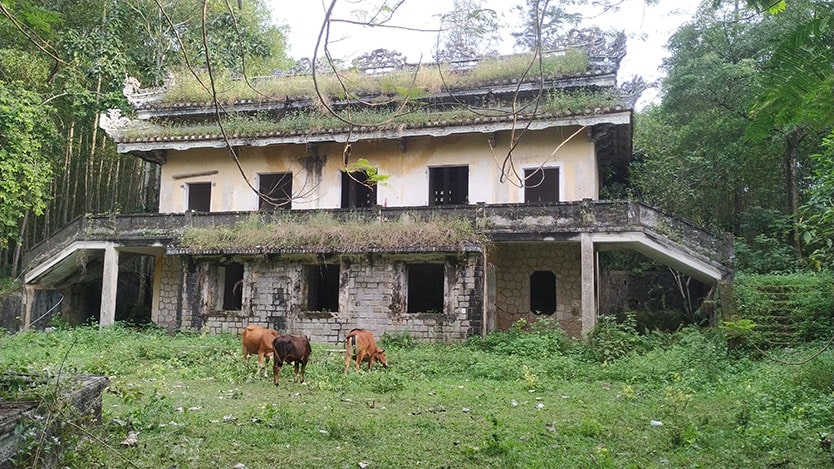
The house is a two storied shell, lodged into the side of the hill. fronted by a four-pillared pavilion that stands above a pond once populated with colourful fish. Roofs of both structures remain intact. External staircases flank either side of the house and behind them, two small gangrene ponds that ripple in curious fashion. The floors of the 2nd floor are dirtied. Syringes and dirtied bed sheets indicate refuge and isolation. Maybe something the security cows can attest to.
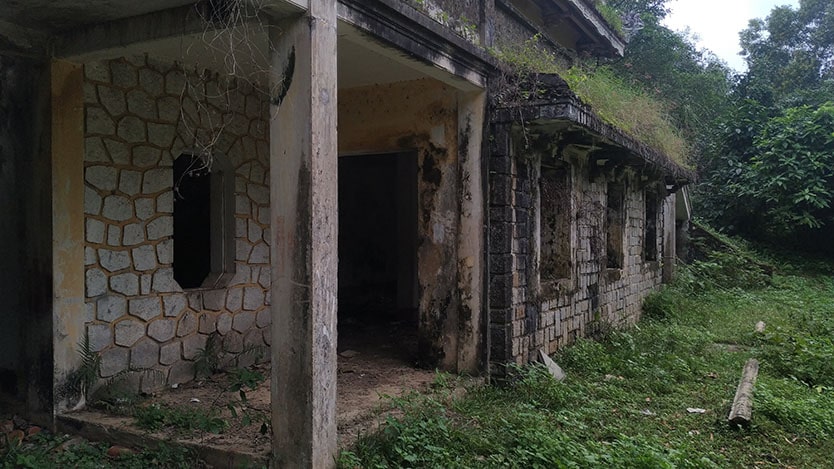
The side of the building leads to a back garden that wonders into bush and rubber plantations. Maybe this was how Ngo Dinh Can escaped the mob that encircled his decadent mansion before he met his end later by the sentence of firing squad in Saigon.
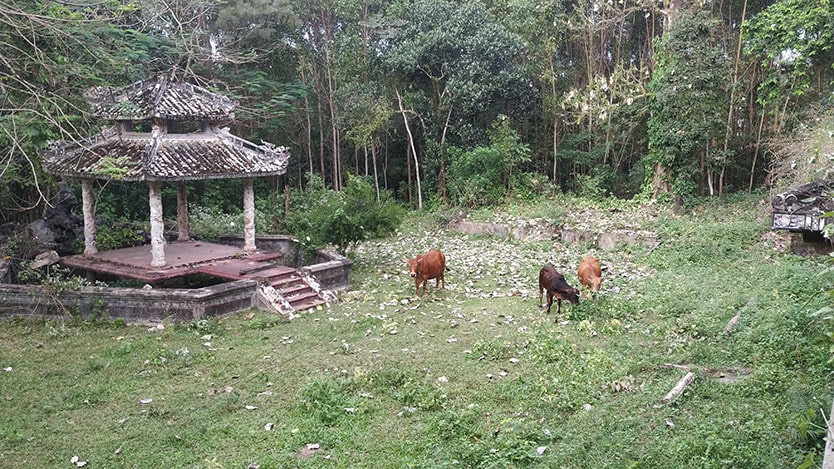
The house is only within a short distance from his secret prison, nine bunkers, where he tortured Hue citizens suspected of dissent. I wonder how many screams of those confined woke him at night and how many he slept through unperturbed.
Hell on Earth: Chin Ham (Nine Bunkers)
The French colonial administration originally built nine bunkers as an ammunition storage unit in 1941, possibly in response to growing communist forces north from here. When Japan took control over Vietnam from the French in world war II, they ransacked the armoury and left it spare.
It wasn’t until ten years later, shortly after the partition of Vietnam that the bunkers were repurposed by the Ngo administration and under the direct command of Ngo Dinh Can. He transformed the bunkers into prisons with tiger cages. At Nine bunkers, he ‘refurbished’ them with tiger cages and tools for torture. People from around central Vietnam suspected as communist sympathisers and political dissidents would be detained here and face violent interrogation. Although there were nine bunkers, only eight of them were used by the Ngo regime. The 9th acted as a watch tower. They contained prisoners specific to their demographic; suspect businessmen in one bunker, protesting Buddhists in another. Anti-Ngo protestors in one, communists and spies in another.

Since the bunkers were recognised as points of national heritage, the government have installed signs and footpaths for visitors to understand better about their former use. There’s a car park at the entrance and a small museum. Opposite the bunkers is a gigantic memorial to pay homage to those that died here. Continue to follow the road past the bunkers for a few kilometres and you’ll arrive at a very vacant Buddhist university. That’s for another post.
The pathways of Nine bunkers climb and fall gently around the grassy mound. Retracing the footsteps of prisoners who were most likely blindfolded and equally uncertain on their fate as much as where they were. The silence is more so eerie than the Ngo Dinh Can mansion. A glance outwards takes you no further than the surrounding forest.

After the fall of the Ngo Regime, it is believed that the bunkers were in-part destroyed due to US bombing when the North Vietnamese forces used them as part of their supply line during the Tet offensive in 1968. While not much of their original structures remains, each bunker is signposted with information about their usage and notable prisoners. Bunker 8 is an exception to this. You will reach the only bunker renovated for the purposes of demonstration on the other side of the hill. Bunker 8 is only open on special occasions of memorial but inside are tiger cages and mannequins re-enacting the roles of guards and prisoners. All of this aided solely by silence which allows the mind to imagine what could be heard when the bunkers were once active.
Out of the city and once well-guarded, the bunkers were not in public knowledge until the fall of the Ngo regime in November 1963. Rumours of their existence didn’t extend any further than speculation before then. A collection of poems named ‘Living in a Grave’ by Nguyen Dan Trung reflect on personal experiences of Nine Bunkers. To this day, texts on their history are limited online in English and I struggle to find many accounts of people who were based there except those who operated under cover as North Vietnamese agents. This is something I look forward to finding more information on.
Dark Tourism in Hue
These two sites alone give a limited picture of the complex history of the Buddhist crisis during the Ngo Family regime. Nevertheless, their very limited coverage on the tourist trail makes them great alternative sites for the budding dark tourist. Their proximity to Graffiti Wall, the Le Ba Dang art museum, the Abandoned Waterpark and the Khai Dinh Tomb make the 9 bunkers and the Ngo Dinh Can mansion great supplements for a day visiting the outskirts of Hue by motorbike.

Other sites that played integral parts to the Buddhist Crisis in Hue are the Tu Dam Pagoda and the former site of the radio station beside the Truong Tien bridge. In Saigon, you can visit the location and memorial for the self-immolating monk Thich Quang Duc as well as the Presidential palace where Diem controlled the country from. Vietnam sure can make for a great dark tourism adventure! Message us if you’re keen on some more dark tourism tips!

