Tiếng Nói Cựu Quân Cán Chính VNCH Tỵ Nạn Hải Ngoại -Thiết Lập Từ Năm 2006.
Mt68 History
Showing posts with label ZohranMamdaniNrwYork. Show all posts
Showing posts with label ZohranMamdaniNrwYork. Show all posts
Saturday, 15 August 2026
CHÚC MỪNG DÂN NEW YORK:
THIÊN ĐƯỜNG XÃ NGHĨA ĐÃ ĐẾN NƠI RỒI! MAMDANI ĐANG DỰ TRÙ CHO MỞ CỬA CÁC " SIÊU THỊ QUỐC DOANH" - NGUỒN VỐN VÔ TẬN TỪ TIỀN THUẾ- SẼ BỚT 30% CHO DI DÂN VÀ LOW INCOME NẾU CÓ THẺ ĐẢNG VIÊN DÂN CHỦ HAY MUSLIM SẼ ĐƯỢC BỚT THÊM 10%- HOMELESS VÀ CƯ DÂN HARLEM SẼ ĐƯỢC FREE- MAMDANI CHO RẰNG "QUỐC DOANH" Ở CÁC NƯỚC XÃ NGHĨA ĐÃ BỊ THẤT BẠI VÌ SHOPLIFTING TRÀN NGẬP - NHƯNG MAMDANI TIN TƯỞNG NEW YORK SẼ KHÁC- SIÊU THỊ QUỐC DOANH SẼ THÀNH CÔNG- VÌ DÂN NEW YORK ĐÃ QUYẾT TÂM GIÚP "SOCIALIST" TIẾN NHANH, TIẾN VỮNG CHẮC LÊN THIÊN ĐÀNG XÃ NGHĨA - GIẢI PHÓNG CẢ NƯỚC MỸ TRONG VÒNG 5, 10 NĂM TỚI THÔI./-Mt68
___________________
Inside Mamdani’s Plan For City Owned Grocery Stores And
The 30% Discount It Promises.
The Mamdani grocery plan would open five publicly owned
supermarkets, one in every borough, and lock a core set of essentials at 30%
below retail, though the opposition is already lining up.
The Mamdani grocery plan came into sharp
focus this week when Mayor Zohran Mamdani stood in East New
York and laid out exactly how New York City intends
to run its own grocery stores and how much shoppers would save. The short
version is five city owned supermarkets, one in each borough, selling a core
basket of everyday essentials at 30% below typical retail prices. The longer
version, including who pays for it, when the stores open, and who is fighting
it, is where the real story lives.
Start with the pricing. Under the Mamdani grocery plan, each
of the five stores will discount a core group of staples by 30% compared to
what those items usually cost at retail. That basket covers all fresh produce,
meat, and seafood, along with eggs, cheese, milk, bread, pasta, and roughly
twenty other pantry and refrigerated goods. Everything outside that core set
would sell at ordinary market prices. The discounts are not tied to income, so
any New Yorker can walk in and pay the lower price, no matter what they earn.
One detail that matters is how the prices behave. Rather
than shifting week to week the way supermarket sales do, the city plans to set
the discounted prices once at the start of each month and hold them there for
the entire month. Mamdani framed this as removing the guesswork and the sticker
shock, telling reporters the savings would last the whole month with no weekly
fluctuations. He also took direct aim at what he called surveillance pricing,
the practice of some retailers using personal data to charge different
customers different amounts for the same item.
[Ad] Time remaining: 0:12
The savings figures in the Mamdani grocery plan deserve a
careful read. The 30% cut applies to that core basket of essentials, but the
city’s own estimate of the effect on a household’s overall grocery bill is more
modest, in the range of 15%, or about $90 a month. That still adds up to
roughly $1,000 a year for a regular shopper, which is real money in a city
where, by the administration’s own accounting, grocery prices have climbed
nearly 66% over the past decade, well ahead of the national pace.
The structure is where this differs from a normal
supermarket. The city owns the land or leases the space, and it covers the cost
of construction or renovation. It then waives rent and property taxes on the
sites, and those savings are meant to flow straight to consumers in the form of
lower prices rather than into profit. The actual running of each store would be
handled by a private grocer or firm, not city employees working the registers.
To find those operators, the administration issued a lengthy request for
proposals, and it is requiring that whoever runs the stores commit to living
wages and the right of workers to organize.
The money and the timeline behind the Mamdani grocery plan
are more sobering than the pricing pitch. Mamdani has allocated $70 million in
capital funds to develop all five sites, and none of this happens overnight.
The first store is expected to open around late 2027, and all five are
projected to be running by 2029, which is the end of the mayor’s
first term. So while the announcements are landing now, New Yorkers will be
waiting years before they can actually shop at one.
Two locations under the Mamdani grocery plan have been named
so far. La Marqueta in East Harlem will house
a roughly 9,000 square foot store built from the ground up,
and a second site is set for the Hunts Point section of the Bronx. The
administration has leaned on the demographics of these neighborhoods to make
its case. Mamdani noted that around 65,000 New Yorkers live
within a short walk of La Marqueta, that thousands of NYCHA residents are
clustered nearby, and that close to 40% of East Harlem residents received
public assistance or SNAP benefits in the past year. Hunts Point, in the South
Bronx, is a neighborhood still carrying the weight of decades of economic
disinvestment. To coordinate the rollout, the city also created an NYC Groceries
Task Force, led by two deputy mayors, to bring in agencies, industry experts,
and local small business owners.
City Hall has been careful to frame the stores as one piece
of a broader food agenda rather than the whole thing, and Mamdani has
repeatedly insisted the goal is not to compete with the corner bodega or the
neighborhood supermarket. That promise is aimed squarely at the loudest
criticism, because the opposition to the Mamdani grocery plan is already
organized and it is not going away.
The most consequential resistance comes from inside city
government. City Council Speaker Julie Menin has raised
concerns about how publicly owned stores could affect existing bodegas and
independent supermarkets, and that matters because the Council ultimately
controls whether the funding gets approved. That sets up real friction between
the mayor and the lawmakers he needs. Beyond City Hall, small business groups
and independent grocers argue that dropping subsidized stores into a market
where profit margins are already razor thin, often just one or two percent,
could destabilize the private grocers who have served these neighborhoods for
years. Their fear is that a store paying no rent and no taxes is not competing
on a level field.
The skepticism reaches the state level too. Governor Kathy
Hochul, a fellow Democrat, distanced herself from the idea, saying plainly
that she favors free enterprise. Critics have also seized on a real world
cautionary tale, pointing to a city owned grocery store in Kansas
City that shut down after years of losses, reported shoplifting
problems, and empty shelves, with the city having sunk millions into keeping it
alive. Opponents treat that as a preview of what New York is signing up for.
Supporters counter that a handful of pilot stores in a city the size of New
York is a modest experiment rather than a takeover of the grocery business, and
that the underlying problem the plan is trying to solve, families priced out of
feeding themselves, is real and getting worse.
That is the full shape of the Mamdani grocery plan as it
stands now. It is ambitious, it is slow, and it is contested. The pricing is
concrete, the 30% discount is specific, and the neighborhoods have been chosen
with clear need in mind. At the same time, the stores are years away, the cost
to taxpayers is real, and the people who control the money and the people who
run the city’s existing grocers are not sold. Whether it becomes a model other
cities copy or a lesson in why government struggles to run a supermarket will
come down to what actually happens after the first doors open in 2027.
In a Friday editorial from the New York Daily News, the outlet tore into Mamdani for failing to attend the new archbishop's installation ceremony, becoming the first city mayor to do so in several decades.
"Mayor Mamdani was wrong and frankly rude to skip Friday’s investiture ofthe new Catholic archbishop of New York, Ronald Hicks. As leader of the city — the whole city — it is important for the mayor — any mayor — to participate in the major milestones of our varied communities and here Mamdani failed," the editorial board wrote.
As noted by the Daily News, the installation of a new archbishop is a "significant event for New York Catholics and for all New Yorkers, and even all Americans," as the New York archbishop is widely seen as the "de facto leader of the American church."
The outlet argued that the mayor "broke new ground with his absence from the ceremony at St. Patrick’s," considering the long-honored tradition of New York City mayors attending the event.
"New York Archbishop-designate Ronald A. Hicks, who is taking over from Cardinal Timothy Dolan, who has held the post since 2009, holds up a letter from Pope Leo XIV declaring his new position during the Installation Mass at St. Patrick's Cathedral in Manhattan in New York City, Feb. 6, 2026. Reuters" />
The Daily News railed that it was "outrageous" Mamdani hadn't yet spoken with the new archbishop, arguing that he's had more than enough time to do so.
"It was on Dec. 18 when fellow Chicagoan, Pope Leo XIV, tapped Hicks to take over in New York from Cardinal Timothy Dolan, who has served 17 years. That was when Mamdani, as mayor-elect, should have made a congratulatory phone call to Hicks in Joliet, Ill., welcoming him to New York," the outlet contended, adding that "Mamdani had 50 days notice" of the installation ceremony.
Despite attending the mayor’s annual prayer breakfast Friday morning at the Main Branch of the New York Public Library, less than 10 blocks from St. Patrick's, the outlet argued that "he could have attended the investiture in the afternoon."
"We know that someone around the mayor carefully keeps track of his days in office, with a sign counting up. Friday was "37 days of a new era." A new era of what? Rudeness? Disrespect? Ignorance?" the Daily News questioned.
"New York Mayor Zohran Mamdani speaks during a press conference on Tuesday, Jan. 27, 2026, in New York City. Associated Press" class="article-image article-image-ux-impr article-image-new expandable" New York Mayor Zohran Mamdani speaks during a press conference on Tuesday, Jan. 27, 2026, in New York City. Associated Press The outlet also compared Mamdani's decision to skip the installation ceremony to former Vice President Kamala Harris' "big mistake" of declining former New York City's Archbishop Timothy Dolan's invitation to attend the annual Al Smith Dinner alongside President Donald Trump.
"Mamdani should not follow her bad example. He should rent a white tie tux and be up on the dais every fall for the next four years," the Daily News asserted. "The next dinner is Oct. 15, a Thursday, at the Waldorf. See you there, Mr. Mayor."
The New York Post similarly criticized the mayor's absence from the ceremony, arguing that Mamdani "committed a cardinal sin last week by dissing millions of area Catholics as the first city mayor in nearly 100 years — and possibly ever — to skip the local archbishop’s installation."
Fox News Digital has reached out to Mamdani for comment, but did not immediately hear back.
Former mayor, Eric Adams, also weighed in on Mamdani's absence, reposting the Post's article on X, saying, "Our religious communities are foundational to New York City, and the Catholic Church’s daily service to our city is indispensable."
"As your former Mayor, I proudly reflect the gratitude of countless New Yorkers and extend a warm welcome to Archbishop Ronald Hicks," he added./-
Thursday, 1 January 2026
LÝ LỊCH VÀ NGUỒN GỐC CỦA MUSLIM ZOHRAN MAMDANI - THỊ TRƯỞNG SOCIALIST NEW YORK TỪ 01-01 - 2026./-Mt68
Mamdani lived in Kampala until he was five, when his family moved to Cape Town, in South Africa's Western Cape province,[14] after his father was appointed head of African studies at the University of Cape Town.[26] He attended St. George's Grammar School in Mowbray from 1996 to 1998,[17][27] during the early post-apartheid years. He later said that the experience of living in Cape Town "taught me what inequality looks like up close... [and] that justice has to be more than an idea; it has to be material".[28]
The family moved to the United States and settled in New York City when Mamdani was seven,[29] and he was raised in Morningside Heights.[30] He has described his upbringing as "privileged", saying, "I never had to want for something, and yet I knew that was not in any way the reality for most New Yorkers."[31] As a child, he was often present on his mother's film sets, where he was loved by members of the film crews, who variously referred to him as "Z", "Zoru", "Fadoose", and "Nonstop Mamdani".[26]
Mamdani attended the Bank Street School for Children on the Upper West Side of Manhattan, where he successfully ran as the independent candidate in a middle school mock election, adopting a platform of "equal rights, anti-war policies that proposed spending money on education rather than the military".[32] In 2003, he returned to Kampala for a year and attended school during his father's sabbatical there;[19] his paternal grandparents and aunt still lived there and helped take care of him while his father was working on the book Good Muslim, Bad Muslim.[33]
Mamdani at the 2016 Johannesburg premiere of Queen of Katwe
Mamdani is a fan of hip-hop and has composed, performed, and produced rap music.[42] Under the moniker Young Cardamom, he collaborated with his best friend, Ugandan rapper HAB (Abdul Bar Hussein), whose origins are in South Sudan,[43][44] as Young Cardamom & HAB. Their first song, "Kanda [Chap Chap]", was about chapati, an Indian flatbread.[45] They performed tracks from their 2016 EPSidda Mukyaalo ("No going back to the village") at the Nyege Nyege festival.[46][47] The pair rapped in languages including Nubi, Luganda, Swahili, and English, partly to create a unique Ugandan style of rap rather than slavishly imitating American rap, and partly to convey that Ugandan residents with roots in other countries are all Ugandan. The chapati was chosen as a symbol because it originates in the Indian subcontinent but has become a Ugandan staple.[44] In their music, they addressed social issues in Uganda, such as corruption and "black and brown relations", as well as colonialism.[48] Young Cardamom & HAB were nominated for "Rookie of the Year" at the inaugural Ugandan (UG) Hip Hop Awards.[49][50]
In 2017, Mamdani released the song "Salaam" under his middle name, Zohran Kwame.[58] In April 2019, under the moniker Mr. Cardamom, he released the single "Nani", an homage to his grandmother. Actress and food writer Madhur Jaffrey portrays Mamdani's grandmother in the video,[59][60][61][62] which pays tribute to Jaffrey and New York's South Asian culture.[59]
2015–2019: Political involvement
Mamdani entered New York City politics as a volunteer for Ali Najmi's campaign in the 2015 special election for the 23rd district of the City Council.[16] Mamdani was inspired to join Najmi's campaign after learning that he was supported by Heems, a New York rapper of Indian descent and co-founder of alternative hip-hop group Das Racist.[42][63] Specifically, Mamdani attributes his involvement in local politics to a 2015 The Village Voice article about Najmi and Heems, whom he described as one of his favorite rappers.[64][65]
Starting in 2018,[69] Mamdani worked as a foreclosure prevention and housing counselor. There, he assisted lower-income immigrant homeowners in Queens with eviction notices and efforts to prevent them from being evicted from their homes. He said the experience motivated him to run for office to address the housing and affordability crisis.[70]
Mamdani at the Resist Fascism Rally in Bryant Park, October 27, 2024
In October 2019, Mamdani announced his campaign to represent New York's 36th State Assembly district, which encompasses Astoria and Long Island City in Queens.[71][72] He was endorsed by the DSA,[73] running on a platform of housing reform, police and prison reform, and public ownership of utilities.[71] Mamdani's June 2020 primary victory over five-term Democratic incumbent Aravella Simotas took almost a month to call,[74] and he won the general election with no Republican opposition in November.[75] Mamdani was reelected without opposition in 2022 and 2024.[76][77]
Mamdani is a member of the DSA's nine-member "State Socialists in Office" bloc in New York and a member of the Muslim Democratic Club of New York.[16][78][79] He was the keynote speaker at the 2023 DSA convention, in which he said "We are special as DSA electeds not because of ourselves; we are special because of our organization".[80][81]
By January 2025, Mamdani was a member of nine Assembly committees: the Committee on Aging; the Committee on Cities; the Committee on Election Law; the Committee on Energy; the Committee on Real Property Taxation; the Black, Puerto Rican, Hispanic & Asian Legislative Caucus; the Puerto Rican/Hispanic Task Force; the Asian Pacific American Task Force; and the Task Force on New Americans.[82]
By May 2025, Mamdani had been the primary sponsor of 20 bills in the Assembly—three of which became law—and the co-sponsor of 238 bills.[83] As a member of the Assembly, he helped launch a successful fare-free bus pilot program and participated in a hunger strike alongside taxi drivers.[84][85]
On October 23, 2024, Mamdani announced his candidacy for mayor of New York City.[86] His platform included support for free city buses and a rent freeze in rent-stabilized housing.[87][88][89] Mamdani also wants the city government to operate five grocery stores—one in each borough—to drive down grocery prices.[90] His platform included support for universal child care and the construction of 200,000 new affordable housing units.[91] He also supports public safety reform and a $30 minimum wage by 2030.[92] His platform called for corporate tax increases and for those earning above $1million annually.[93]
Third-party posters in support of Mamdani's electoral campaign as seen in Stuyvesant Town in May 2025
For most of the primary campaign, Mamdani trailed former New York governor Andrew Cuomo in polling. He and Cuomo raised similar amounts of money, but his donor base was considerably larger than Cuomo's.[94] A poll taken shortly before the June 24, 2025, primary election showed that Mamdani had caught up to Cuomo.[95]First-choice results on election night showed Mamdani had a large lead over Cuomo,[96][97] who conceded the race that evening.[98] His polling margin was increased by ranked choice voting, particularly because he and third-favored candidate Brad Lander cross-endorsed each other by asking their voters to rank the other candidate second.[99][100][101][102] Mamdani and Michael Blake also cross-endorsed each other a few days later.[103] On June 16, The New York Times editorial board advised voters not to rank Mamdani while criticizing Cuomo.[104]
On July 1, after the New York City Board of Elections released its ranked-choice ballot tabulation, the Associated Press announced Mamdani had won the primary.[105] It was considered a major upset.[106] A July 2025 poll indicated a shift in Jewish American political attitudes, with 43% of Jewish New Yorkers and 67% of Jewish voters under 44 planning to support Mamdani—levels of support suggesting waning attachment to traditional pro-Israel politics. However, many Jewish leaders and voters remained critical of him.[107] Mamdani's campaign launch drew media attention for its use of Bollywood songs and cultural references, which aimed to engage younger and immigrant voters.[108][109]
During the primary, Mamdani's campaign was supported by the New Yorkers for Lower Costs super PAC, which spent approximately $1.3 million supporting him and opposing Cuomo before the primary and raised an additional $1 million afterward. The super PAC received $100,000 in contributions from the Unity and Justice Fund in May and June 2025. Cuomo accused Mamdani of accepting "dirty money", saying the Unity and Justice Fund was tied to the Council on American-Islamic Relations.[110]
Mamdani with Colombian President Gustavo Petro in New York City, September 26, 2025
After Mamdani won the primary, criticisms of and attacks against him used racist, xenophobic, and Islamophobic tropes, particularly references to the 9/11 attacks and terrorism.[111][112] These criticisms and attacks came from across the political spectrum, and sparked concern and debate over Islamophobia in mainstream American politics.[113][114][115][116] The success of Mamdani's campaign was attributed in part to his use of social media to reach potential voters, especially younger voters.[117][118]
In early November, President Donald Trump threatened to withdraw federal funding for New York City should Mamdani be elected mayor.[119] Mamdani was elected mayor on November 4, 2025.[120][121][122] He is the city's youngest mayor since 1892, as well as the city's first Indian American and Muslim mayor.[123][124][125][126]
On November 5, 2025, the day after the election, Mamdani announced the first members of his mayoral transition team, with Elana Leopold as executive director, and co-chairs Maria Torres-Springer, the former first deputy mayor; Lina Khan, the former chair of the Federal Trade Commission; and nonprofit executives Melanie Hartzog and Grace Bonilla.[127] On November 10, he announced his selection of former first deputy mayor Dean Fuleihan as his first deputy, and his former Assembly chief of staff and campaign manager Elle Bisgaard-Church as his Chief of Staff.[128]
Mamdani met with President Trump at the White House on November 21. A spokesperson said the discussion would focus on public safety, economic security, and affordability.[129][130] After the meeting, Trump praised Mamdani and said they "agree on a lot more than I would have thought", following months of mutual criticism.[131][132]
According to a December Anti-Defamation League report, about 20% of Mamdani's transition team is affiliated with anti-Zionist organizations, such as Jewish Voice for Peace and Within Our Lifetime.[133][134][135] An Anti-Defamation League report four days earlier found antisemitic social media posts, such as one describing "money-hungry" Jews, by Mamdani's director of appointments. She resigned after the posts were publicized.[136]
Mamdani at his public swearing-in as New York City mayor on January 1, 2026
Mamdani's mayoralty began on January 1, 2026, with New York Attorney General Letitia James administering the oath of office in the abandoned City Hall subway station. Mamdani took the oath on the Quran, making him the first mayor of the city to do so. Additionally, he took the oath on two Qurans, one of which was his grandfather's and the other belonged to Arturo Alfonso Schomburg.[137] A public inauguration was held in the afternoon of January 1; Mamdani was sworn in by Bernie Sanders.[138][139] Speakers and performers at the inauguration included Sanders, Alexadria Ocasio-Cortez, Javier Muñoz, Lucy Dacus and Mandy Patinkin.[140]
Mamdani's first act as mayor was signing an executive order revoking all executive orders his predecessor Eric Adams made after he was indicted on bribery charges.[141]
Mamdani supported Proposal 1—a successful 2024 ballot measure that banned discrimination based on ethnicity, gender identity, disability, and reproductive rights—and backs single-payer healthcare through the New York Health Act.[157][158][159][160] He argues that "dignified work, economic stability, and well-resourced neighborhoods" prevent harm better than policing, proposing a civilian Department of Community Safety to handle mental health crises and community outreach.[161] He has voiced support for defunding the NYPD and accused the department of racism, for which he later apologized. As a mayoral candidate, he instead emphasized building a cooperative relationship with the department on violent crime prevention while reducing the involvement of police in other matters.[162][163][164]
Mamdani connects environmental justice to social equity.[182] He opposed expansion of the gas-fired Astoria Energy power plant,[183][184] supports the All-Electric Buildings Act and congestion pricing, and proposed a "Green Schools for a Healthier New York City" plan to retrofit schools with solar panels, create green schoolyards, and establish resilience hubs.[185][186][187] His platform includes universal pre-K, baby baskets for new families, defending Hasidic yeshivas' autonomy,[188] expanding sanctuary protections for immigrants, making New York City an LGBTQ+ sanctuary city with an Office of LGBTQIA+ Affairs, and eliminating bus fares through expanded MTA funding and free transit initiatives.[f]
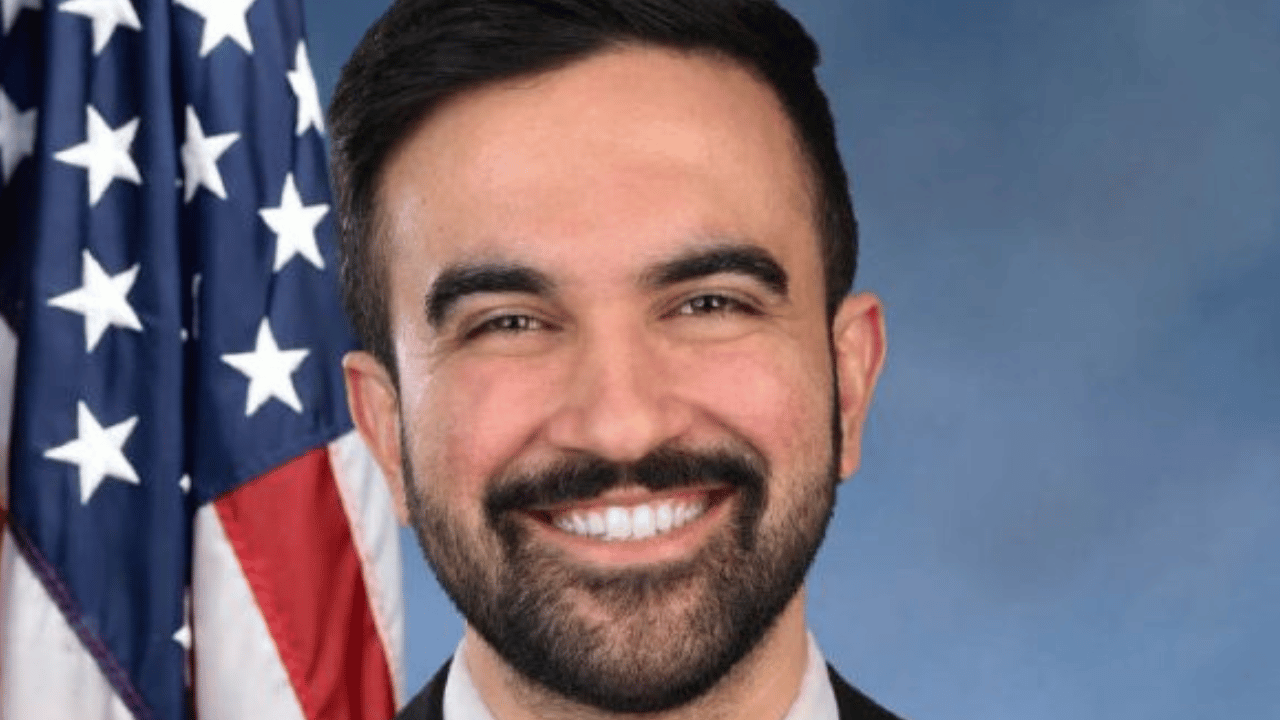

_(cropped).jpg)

.jpg)


